
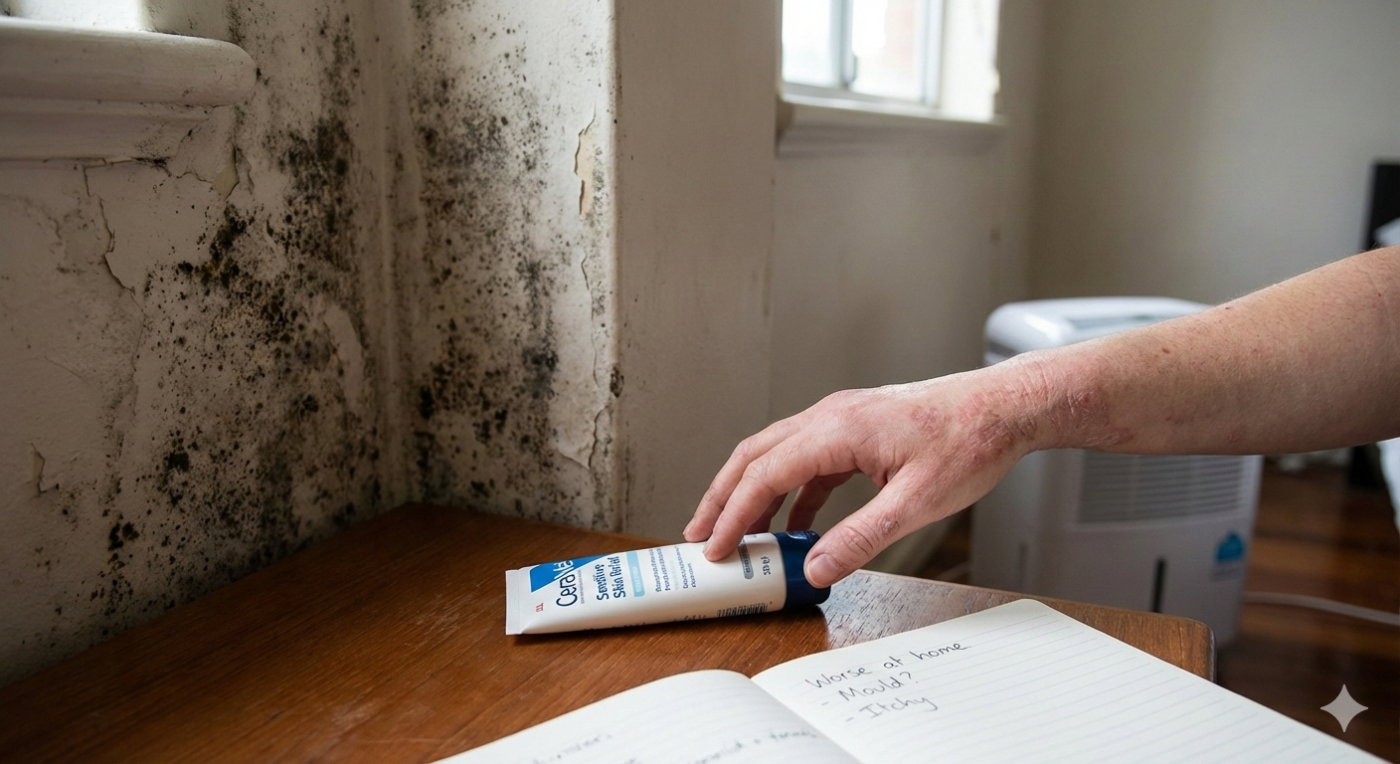
Mould is far more common than most people realise — especially in humid climates like Sydney. It exists in homes, workplaces, schools, and even new buildings. And while mould affects everyone at some level, not everyone shows symptoms straight away.
For people with eczema, allergies, or existing immune sensitivity, mould exposure often shows up earlier and more clearly — through the skin.
This doesn’t mean mould is harmless for others. It means that eczema-prone skin is often one of the first places the body signals that something is off.
Mould Affects Everyone — Symptoms Just Appear Differently
Mould exposure places a low-level stress on the body’s systems. Some people tolerate this load for years without obvious symptoms. Others, particularly those with eczema, feel the effects much sooner.
This difference is not about weakness — it’s about immune sensitivity and threshold.
People with eczema often have:
• a more reactive immune system
• a compromised skin barrier
• higher baseline inflammation
• increased histamine sensitivity
Because of this, their bodies tend to reach a “symptom threshold” faster when exposed to environmental stressors like mould.
How Mould Impacts the Body (Not Just the Skin)
Mould doesn’t affect a single organ in isolation. Its influence is cumulative and systemic.
Immune system
Mould spores are recognised as foreign by the immune system. In susceptible individuals, this can lead to ongoing immune activation, increasing inflammation and allergic-type responses — which often appear as eczema flares.
Respiratory system
Mould is well known to aggravate:
• sinus congestion
• sneezing
• asthma
• chronic cough
Skin and respiratory symptoms often travel together because they share immune pathways.
Nervous system
Some people exposed to mould experience:
• headaches
• brain fog
• poor concentration
• sleep disturbances
The nervous system also plays a key role in itch perception and skin repair, which is why eczema often worsens when this system is under stress.
Digestive system
Immune activation can disrupt gut–immune communication, contributing to bloating, food sensitivity, or digestive discomfort — all of which are commonly linked with eczema.
Liver and detoxification pathways
The body constantly processes environmental exposures. When overall exposure load is high, systems responsible for clearing inflammatory by-products can become overwhelmed, increasing skin reactivity and fatigue in sensitive individuals.
Why Eczema Often Appears First
The skin is one of the body’s largest immune organs. When internal systems are under strain, the skin frequently becomes the place where imbalance shows up first.
This is why mould exposure may present as:
• persistent or worsening eczema
• itching without a clear trigger
• facial, neck, or eyelid flares
• symptoms that worsen at home or overnight
• flares that improve when away from a certain environment
For many people, eczema is not the problem — it’s the signal.
Children and Immune-Sensitive Individuals Are More Vulnerable
Babies and children are particularly affected by mould because:
• their immune systems are still developing
• their skin barriers are thinner
• their detoxification pathways are immature
• they spend more time indoors
Similarly, adults with long-standing eczema, allergies, asthma, or chronic inflammation tend to react earlier because their systems already operate closer to their tolerance limit.
Why Treating Only the Skin Often Falls Short
If mould exposure is ongoing, creams and skincare alone may provide limited relief. The immune system may remain activated in the background, making flares harder to calm and healing slower.
This is why some people feel stuck despite “doing everything right”.
When environmental load is addressed alongside skin, immune, gut, and nervous system health, improvement often becomes more sustainable.
When to Consider Having Your Home Checked for Mould
If someone in your household experiences eczema, psoriasis, allergies, asthma, or ongoing immune-related symptoms, it can be worthwhile to consider whether mould exposure may be contributing — especially if symptoms:
• worsen at home
• flare overnight or in the morning
• improve when away from the house
• persist despite good skincare and lifestyle habits
• affect multiple family members
Because mould is often hidden behind walls, under flooring, or in ventilation systems, it isn’t always visible or obvious.
For those who want to explore this further, the Australian Society of Building Biologists (ASBB) provides access to trained practitioners who assess indoor environments for mould and other biological stressors using evidence-based methods.
You can find qualified practitioners through their directory here:
https://www.asbb.org.au/practioner-map#!directory/map
This can be particularly helpful for families where children or adults have chronic skin conditions or allergic tendencies, as reducing ongoing environmental load may support overall healing.
Final Thoughts
Mould affects everyone. The difference lies in how quickly and visibly the body responds.
Some people may not show symptoms until years later. Others — especially those with eczema or existing immune sensitivity — experience skin flares much earlier, because their bodies are already more reactive.
Understanding mould as a whole-body stressor helps explain why eczema can be persistent, unpredictable, or resistant to surface-level treatment.
By taking a broader view of health — one that includes environment as well as internal balance — the skin is often able to calm and heal more naturally.
At our Eczema & Psoriasis Clinic in Sydney, we consider not just what’s happening on the skin, but what the skin may be responding to.
[Book A Consultation Now] | [Contact Us] | [Follow Us on Instagram @eczemapsoriasisclinic]
